Wenn Sie Teilnehmer aus einer externen Quelle importieren möchten, können Sie dies über eine Excel/CSV-Datei mit dem Teilnehmer-Import unter Teilnehmer > Teilnehmer-Import machen. Beginnen Sie mit der Auswahl der Import-Datei. Die zu importierenden Daten müssen sich hierbei zwingend im ersten Arbeitsblatt der Datei befinden. In der Import-Vorschau können Sie dann Spalten zu Feldern zuweisen und wählen, auf welcher Basis Teilnehmer identifiziert werden.
Best Practice
- Die erste Zeile enthält Spaltenüberschriften. Diese bestimmen, in welches Feld die Werte der Spalte standardmäßig importiert werden sollen. Diese Zuordnung kann in der Import-Vorschau überschrieben werden.
- Eine Excel-Vorlage mit einigen Standardfeldern steht zum Download bereit. Verwenden Sie diese Vorlage gerne für einfache Import-Dateien.
- Es ist wichtig, dass Sie nur eines der Felder Alter, Geburtstag und Jahrgang importieren. Die Felder sind untereinander abhängig und ein Import von mehreren Feldern führt zu Konflikten und fehlerhaften Daten. Weitere Informationen zu diesen Feldern finden Sie unter Jahrgang und Geburtstag.
Feldzuordnung

Die Werte aus der ersten Zeile werden automatisch für die Zuordnung der Spalten zu den Feldern in der Veranstaltungsdatei herangezogen. Diese Werte werden standardmäßig nicht importiert. Verfügt Ihre Importdatei über keine Kopfzeile, setzen Sie den Haken links, um diese Werte ebenfalls zu importieren. In diesem Fall müssen Sie für jede Spalte die Zuordnung zu Feldern in der Datenbank definieren. Felder, die nicht zugeordnet werden können, werden über ein  gekennzeichnet. Für die Zuordnung gibt es drei Optionen:
- Zuordnung zu bestehendem Feld: Klicken Sie in der Vorschau auf die Überschrift und passen sofern notwendig den Feldnamen an. Die Feld-Auswahl hilft Ihnen hierbei, das richtige Feld zu finden.
- Neues Zusatzfeld anlegen: Kann der Wert der Kopfzelle nicht zugeordnet werden und ist über das Fragezeichen gekennzeichnet, wird beim Import hierfür ein neues Zusatzfeld erstellt.
- Spalte beim Import überspringen: Lösen Sie den Haken für Spalte importieren. Die Spalte wird nun beim Import übersprungen und nicht importiert.
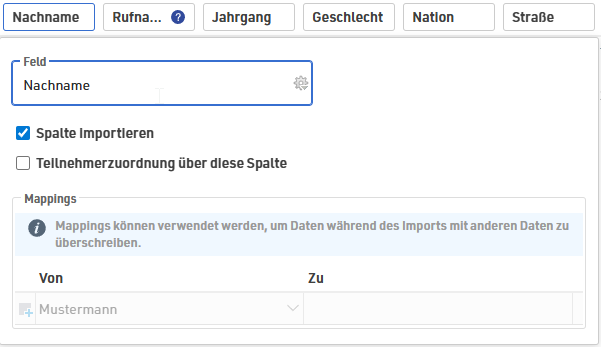
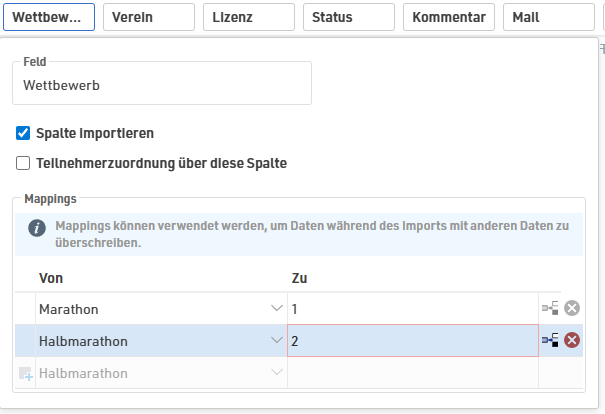
Über Mappings können Sie zudem eine Zuordnung von Feldern aus dem Import zu Werten in der Veranstaltungsdatei definieren. Dies ist empfehlenswert, wenn das Format der Import-Datei nicht mit dem Format in RACE RESULT 14 übereinstimmt. Oftmals ist dies der Fall bei der Umwandlung von Wettbewerbsnamen zu Wettbewerbs-ID oder bei der Interpretation des Geschlechts (Männlich -> m, Weiblich -> f).
Teilnehmerzuordnung
Die Einstellung Teilnehmerzuordnung über diese Spalte bestimmt, nach welchen Kriterien Teilnehmer beim Aktualisieren identifiziert werden. Am einfachsten ist es beim Aktualisieren von Daten die Teilnehmer über die Startnummer zu identifizieren. Standardmäßig ist bei Vorliegen der Spalte Startnr diese als Teilnehmerzuordnung vorausgewählt. Passen Sie dies nach Bedarf an, um bspw. die Startnummer zu ändern oder wenn die Startnummer in Ihrer Excel-Datei nicht vorliegt. Gibt es mehrere Datensätze mit identischen Werten, so dass nicht eindeutig identifziert werden kann, erhalten Sie beim Import eine Fehlermeldung.
Die Spalten und Felder, über die die Zuordnung vorgenommen wird, werden über ein Schlüsselsymbol  gekennzeichnet.
Import-Modus
Es gibt drei Import-Modi. Standardmäßig ist Nur neue Teilnehmer hinzufügen ausgewählt. Unten links in der Vorschau können Sie den Modus ändern.
| Modus | Beschreibung | Teilnehmerzuordnung |
| Nur neue Teilnehmer hinzufügen | Aus der zu importierenden Datei werden nur neue Teilnehmer erstellt. Ist eine Startnummer aus der Import-Datei bereits in der Veranstaltungsdatei enthalten, wird diese Zeile beim Import übersprungen. | Optional |
| Nur bestehende Teilnehmer aktualisieren | Aktualisiert alle Datensätze basierend auf der gewählten Teilnehmerzuordnung. | Notwendig |
| Hinzufügen und aktualisieren | Aktualisiert Datensätze sofern über die Teilnehmerzuordnung identifizierbar und erstellt für alle sonstigen Zeilen neue Datensätze. | Notwendig |
Ist in der Import-Datei keine Startnummer enthalten, wird beim Erstellen neuer Datensätze automatisch eine Startnummer gemäß den Einstellungen unter Teilnehmereingabe vergeben. Ist eine Startnummer enthalten, die Startnummer wird für die Zuordnung verwendet und diese Startnummer liegt in der Veranstaltungsdatei bereits vor, wird dieser Datensatz aktualisiert - sofern der entsprechende Modus gewählt ist.
Zusätzliche Hinweise
Wenn Sie regelmäßig Daten desselben Formats importieren, können Sie die Feldzuordnung speichern und hierfür eine Vorlage erstellen. Wählen SIe zudem eine Vorlage als Standard, um diese beim Öffnen des Imports direkt aufzurufen.
Importing Participants by Event File
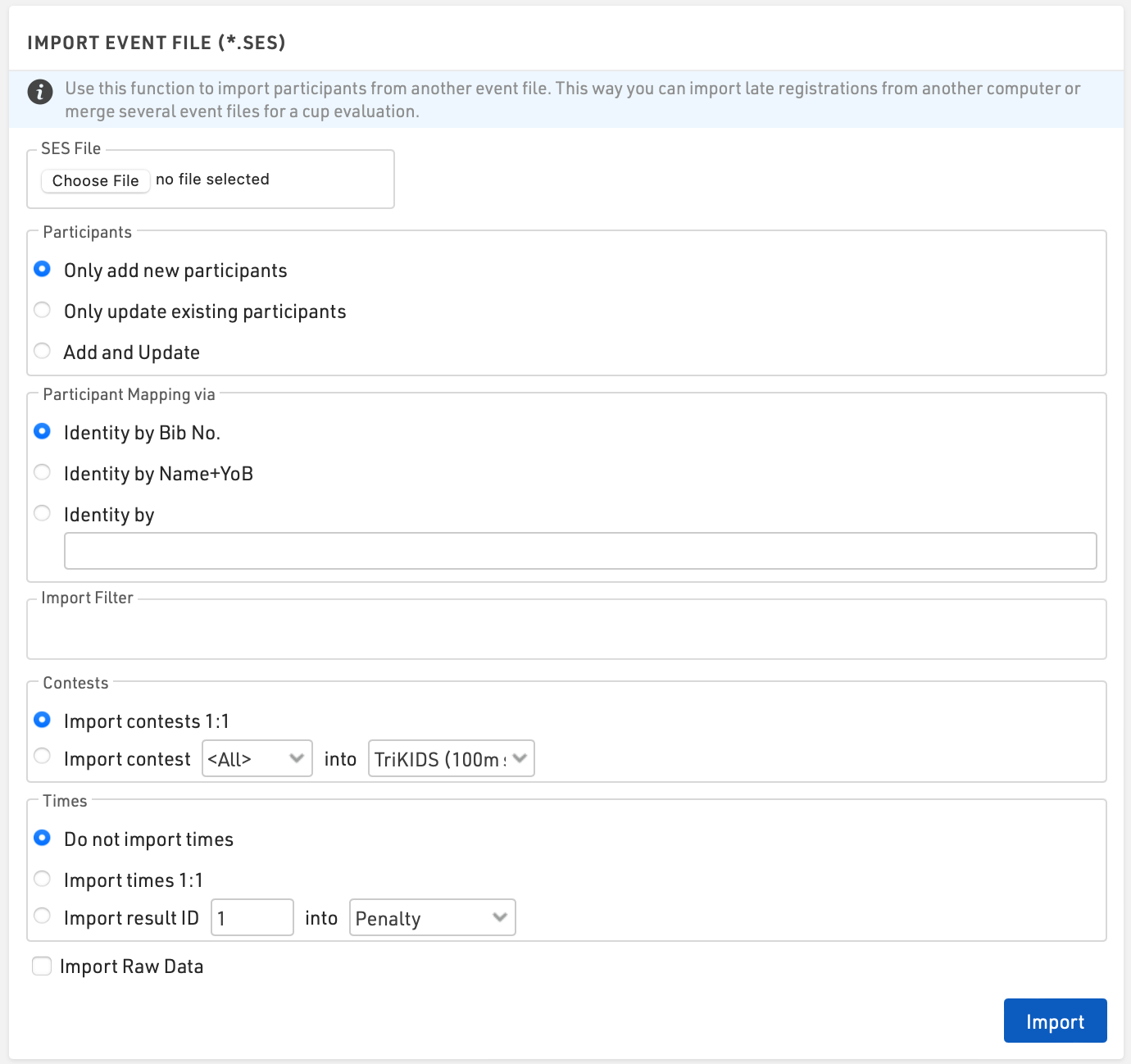
Used to import participants and times from another event file. This way you can import late registrations from another computer or merge several event files for a series evaluation.
Tip: When importing and identifying participants it is recommended that you first make a local backup of the event file.
Participants
Choose how to handle the data you are importing
- Only add new participants
- Only update existing participants
- Add and Update
Participant Mapping
Most commonly participants are identified by bib. If participants do not use the same bib number, alternative identity options such as Name+YOB or a unique identifier such as Registration Number can be used.
Filter
A filter can be applied to the import, for example, you may only want to import records for bibs between 1 and 500 or for a specific Contest
Contests
Participants will be assigned to a Contest according to the contest matching settings.
Contest 1:1 requires the contest ID number of both event files to match exactly. This option is commonly used when a copy of the same event files is being used, such as when late registrations are being taken.
Contests that do not have matching ID’s can be imported by selecting the contest number and corresponding contest name.
Tip: If a participant enters a series event and changes contests partway you should identify participants by your preferred identifier and contest e.g. [Bib] & [Contest].
Times
Times in Special Results can be imported similarly in the same way. Times with matching result IDs can be imported with Times 1:1. If the imported file is being used for a series evaluation you can map the result ID into another result field.
Raw Data
When the option Import Raw Data is selected, all Raw Data records will be imported. It is important that the timing points name match in both files.
Possible Excel import error messages
When importing participants it is possible to receive an error message if something in your import file is incorrect. Below is a list of possible error messages with explanations and possible fixes.
Bib Not Unique, Bib xx.
- This indicates you have more than one of the same bib numbers in the Bib column.
- In your Excel file, check the Bib column for duplicates. It helps to sort your file by the Bib value.
Bib Existing
- This error happens when you are trying to import a list of participants and mapping on a value other than Bib.
- This error indicates that one of the participants being imported has a Bib value that already exists in the event file and the mapping value does not line up.
- For example, Bib 100 exists in the event file with a mapping value of 1. You try to import bib 100 under a mapping value of 2. Bib Existing error will be thrown.
Bib must not be negative
- The Bib column must not be a negative number
- The Bib column must be a whole number, not decimal values
No columns for participant mapping selected
- When using the import mode "only update existing particiapnts", you must define at least one mapping field.
[n] row(s) with empty particiapnt mapping fields
- When using the import mode "only update existing participants", all participants being imported must have a value in the column used for mapping.
- [n] represents the number of rows effected
- effected rows will be highlighted in red
participant mapping fields are not unique in import date: John, Doe
- This means that two rows in your import file have the same mapping values
- In the above, John, Doe is listed twice in the import file
participant mapping fields are not unique in existing event: John, Doe
- This means that there are duplicate mapping values in the event file
- In the above, John, Doe exists as two participants in the event file