Using Splits is straightforward. In this approach, the system simply looks for a chip detection at the start line and one at the finish line. The participant's net time is calculated as the difference between the two.
To make this work, you'll need to create two Split Points in your RACE RESULT 14 event file: one for the start, and one for the finish. The start split should be configured with an open detection window, usually about an hour, to allow participants to start at any moment within that time frame. The finish split functions like any other chip-based finish detection.
Once those two split times are recorded, RACE RESULT can calculate the time each participant took to complete the course — no further configuration needed. This is the go-to solution when start times don’t have to be exact or scheduled.
Start and Finish at the Same Point
In this scenario, both start and finish are recorded using the same timing point — for example, a 20 km loop where participants start and finish at the same line.
The Start Split uses the same timing point as the finish but is configured with the type “This is the start (first read)”. The method is Time of Day, with the time window restricted from 10:00:00 to 12:00:00. This ensures that the last valid detection in that interval is taken as the official start time. Alternatively, it's possible to refer to T0 and use race time, with a minimum of 0 and a maximum of 2:00:00 or more hours.

The Finish Split also uses the same timing point, and take the first valid detection matching the expected speed range (e.g. 5 km/h to 60 km/h), based on the course distance.

Since the start detection is based on the first read, it is essential that participants do not wait around the timing point before beginning. The setup assumes a “flying start”, where participants wait at least 10 meters before the timing line and cross it only when they actively start their effort.
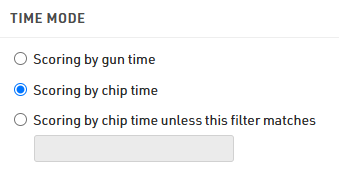
To ensure correct net time calculation, the Time Mode in the splits must be set to Chip Time, not Gun Time.