The detection of Active Trackpings is the same for both varieties of Track Boxes, using the on-board 2.4GHz module to receive passings.
If using a Track Box Passive to receive Trackpings then additional consideration should be taken for mounting the devices due to the decreased detection radius, additionally Dual Track Box Synchronization should not be used when also recording Active Trackpings.
Track Ping Detection
Track Boxes operate using 2.4GHz for communication, and can be set to one of 8 channels and tracking mode on Transponders should be activated on the same channel. Since these are the same 2.4GHz channels used by transponders for communication with active timing systems, the channel used for tracking mode should be different from those used for timing points to prevent saturation of the 2.4GHz channel.
When active the Track Boxes are constantly waiting to receive Track Pings from transponders which have tracking mode activated. The range of the antenna ensures that Track Pings should be received within a minimum radius of 50m, in clear environments with little interference this range may be even wider.
Since Track Pings are sent in a short interval (interval depends on the transponder and the current status), the Track Box is likely to receive multiple Track Pings from each transponder. To optimize the accuracy and reliability of data the Track Box uses a detection algorithm to only send the most accurate time or recently seen transponders.
For each Track Ping received the Track Box also sends an acknowledgement to the Transponder, this ensures the transponder's tracking mode remains activated according to the tracking mode time limits.
Times will be sent in batches, the frequency of which depends on the number of Track Pings being received. If no Track Pings are being received then the Track Box will only communicate with the server every 4 minutes.
Track Ping Algorithms: Stationary vs. Moving
Track Boxes have integrated motion sensors which allow them to determine whether they are currently moving, or stationary, which has an impact on the way they manage trackpings sent by nearby transponders.
Stationary Algorithm
When a Track Box considers itself stationary, it tries to calculate and send the most accurate time possible, much in the same way as our traditional timing systems.
For Active Trackpings there are 2 values to consider:
- Maximum Observation Time (30s): The maximum length of time a transponder is monitored for before sending a passing. This minimizes delays in receiving passing data if a transponder remains in range of a Track Box for a long period of time.
- Reaction Time (10s): How long the device will wait for a TrackPing with a higher RSSI value before sending the data, except if the Maximum Observation Time is reached. This behaves in a similar manner to the Reaction Time of a Decoder.
If a Trackping with a higher RSSi is received within 10s of the previous strongest signal then the transponder will continue to be monitored, unless 30s has elapsed from the first TrackPing received from the transponder. After a passing is stored then the Maximum Observation Time will reset.
In this mode, you may expect the detection to be accurate to approx 1 second, if the participants are traveling fast enough. If the participants are traveling slowly and staying in range of the Track Box for a long time, you are likely to receive several passings.
Moving Algorithm
A Track Box will switch to the moving algorithm as soon as it detects that it has been traveling at over 5 km/h.
When the Track Box considers it is moving, it does not make sense anymore to follow the transponders for a certain time to try and determine the highest signal strength, since both the Track Box and transponders are moving.
The Track Box then groups all the trackpings received and sends them every 10 s.
If the Track Box stops moving for over 1 minute, it will switch back to the stationary algorithm.
For every trackping, the Track Box indicates which algorithm was used. More information about this is available in the TrackBox Protocol.
For timing purposes, you obviously need your Track Boxes to be stationary at the timing location. Placing Track Boxes on an object that is moving slightly (e.g. on a tree, or on a floating boat or buoy) should not be a problem, as Track Boxes are able to ignore small movements.
Detection range: standard vs. directional antenna
Active Track Boxes are delivered with the same standard antenna as other active system devices. With the standard antenna, in a typical use case you should detect trackpings from all transponders within a 50 m radius, and may probably detect trackpings at a much wider range.
If using the Track Box Passive to receive Active Trackpings then the range will be reduced as the 2.4GHz antenna is only internal.
If you need to receive trackpings from a longer distance, you may consider using the 14 dBi high-gain directional antenna available in our shop. With this antenna, you can detect trackpings up to 700 m away in the direction the antenna is facing. It is important to note that the range is only slightly reduced in all other directions when compared to the standard antenna, transponders will likely be detected at the standard radius of 50m, regardless of the antenna used.
Important: the high-gain directional antenna is only to be used with Track Boxes, to receive trackpings! Using it with other active timing devices exceeds regulatory limits on transmission power.
Here is a graphic representation of the ranges you can expect from each type of antenna:
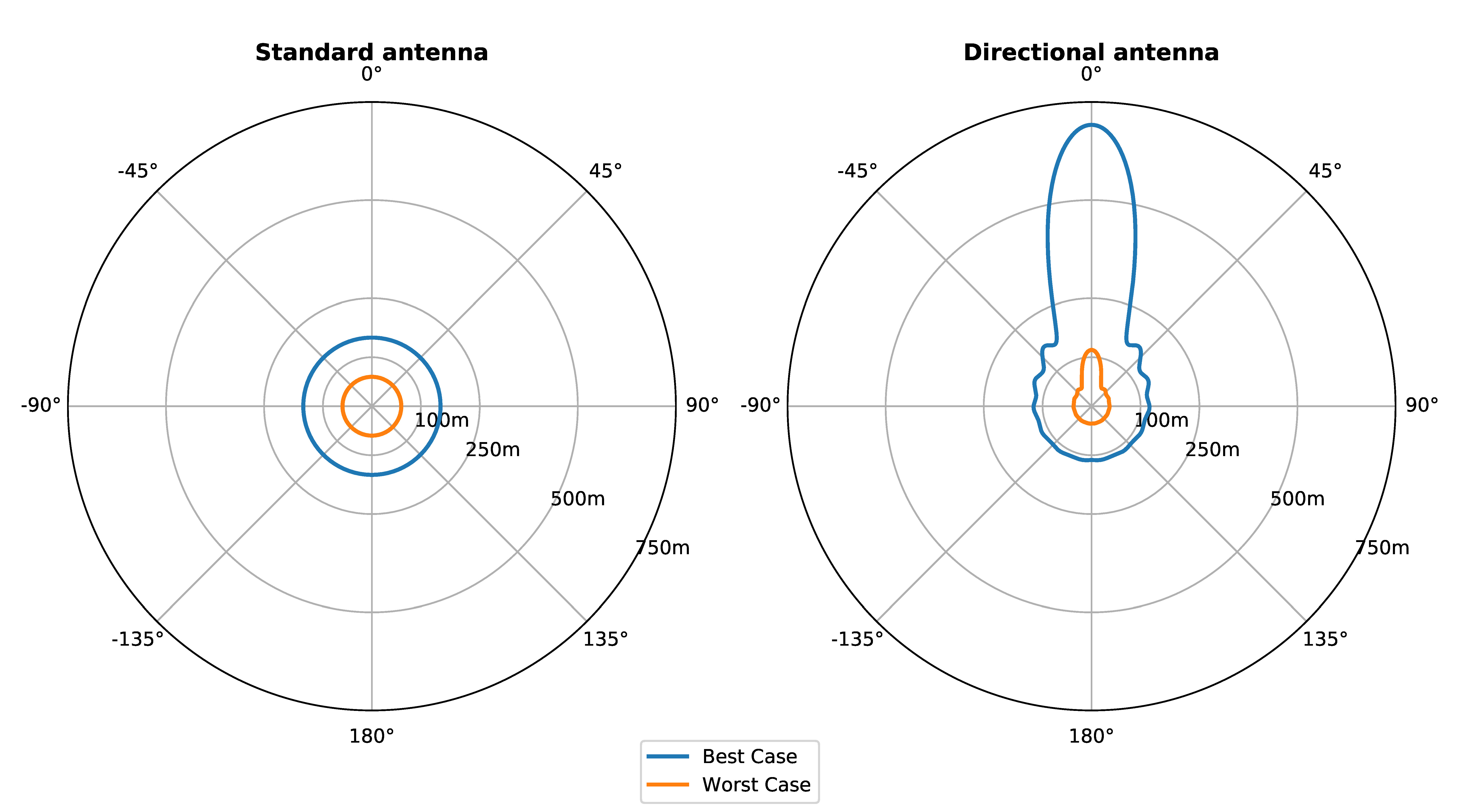
Note that these are only estimates, you may actually detect trackpings from further away depending on the environment, for example next to a lake or a river. Note that the orientation and immediate surroundings of the transponder will have a big influence on the range you can expect. Track Pings sent while the transponder is under water will of course not be received, and while in free air, any obstacle between the transponder and the Track Box (e.g. a wetsuit, the participant's body, etc.) will reduce the detection range.
Practical Applications
Stand Up Paddle on a River
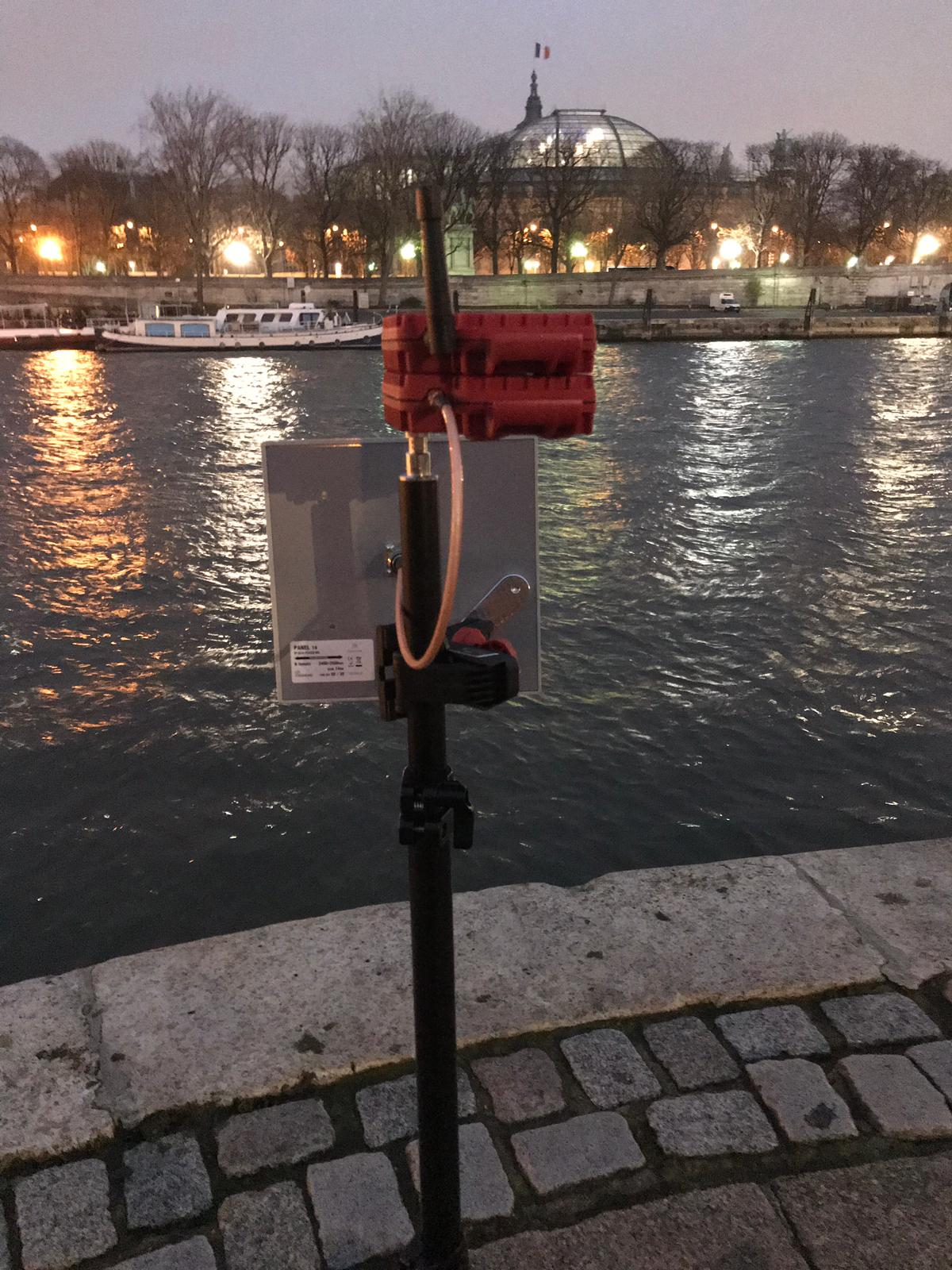
At an SUP in early December 2018, we set up split timing locations with two active Track Boxes, one using a directional antenna, the other with a standard antenna. Here is a picture of the set up at one of the splits, and a chart showing the RSSI values of the trackpings with the directional antenna (in orange) and the normal antenna (in black). The paddlers were crossing the timing point on the opposite side of the river.
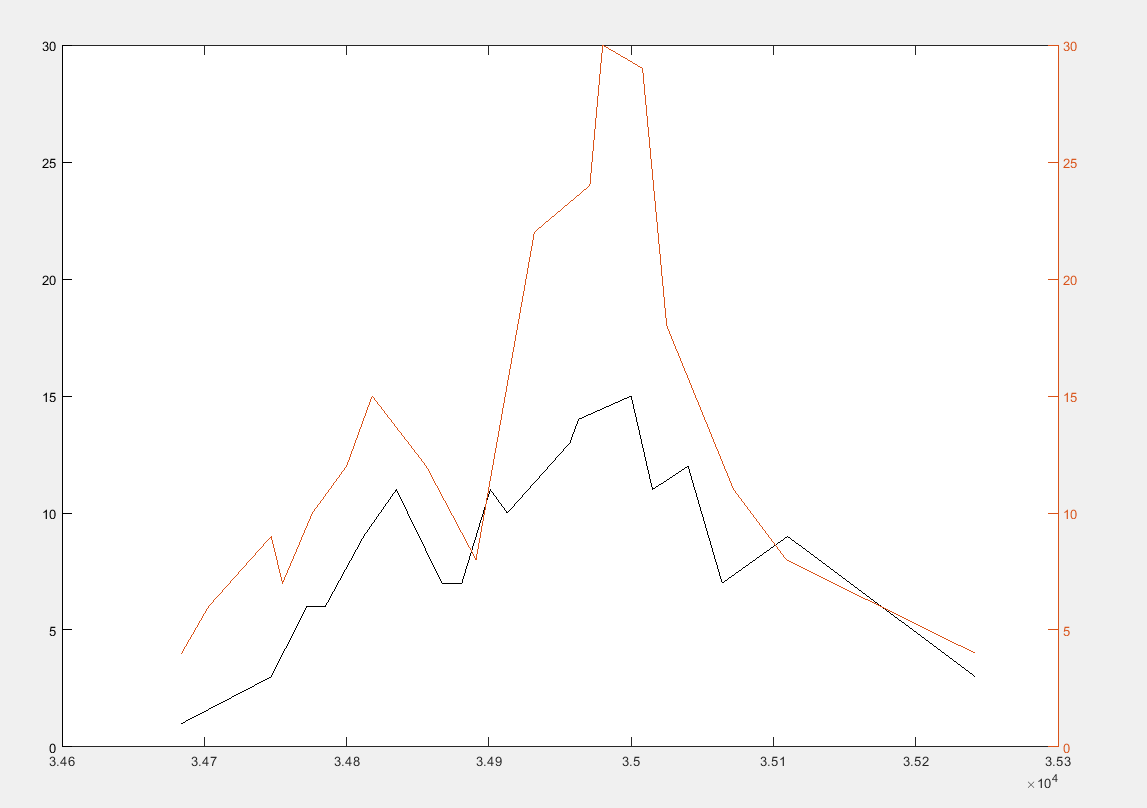
As the charts show, the directional antenna records trackpings with a higher signal strength, and the peak in signal strength is more pronounced. In such a use case, the directional antenna makes it more likely to receive the trackpings, even at longer ranges, and makes it easier to identify the closest detection from several detections received because of the low speed. Here we would recommend using the direction antenna.
Bike split of a triathlon event
At a long distance triathlon event in June 2018, we tested the accuracy of two active Track Boxes (one with a directional antenna, the other with a normal antenna) against a decoder with Active Extension at a split on the bike course that was crossed 4 times.
Below is all the raw data collected from this point for the winner of the event. The data is highlighted in green (decoder), pink (Track Box with standard antenna) and blue (Track Box with directional antenna)
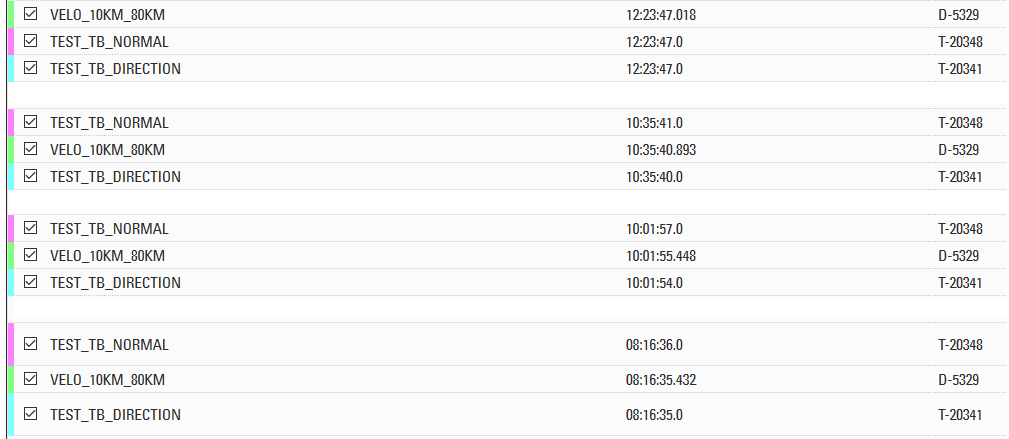
As you can see, for each crossing, the Track Boxes consistently collected only one trackping, and recorded a time that is normally within 1 second of the decoder detection, regardless of the type of antenna used.
In this case, at close range and high speed, the directional antenna does not provide any advantage compared to the standard antenna.
Active Modes
The Mode set through Track Box Configuration Rules changes how often the Track Box Active communicates with the server, and therefore how quickly Track Pings arrive and how long the battery lasts. The Track Box Active supports normal, fast and standby mode. Slow mode is a Track Box Passive mode and is rejected if it is set on a Track Box Active.
Normal
Normal mode is the best compromise between battery life and speed of data, and is recommended for general timing. The box sends a status call every 4 minutes and goes online to send Track Pings as they are received, so a Track Ping reaches the server within 30 seconds. The GPS module is switched off automatically while the box is not moving.
Fast
In fast mode the box stays online permanently and sends a status call every 15 to 60 seconds, so a Track Ping reaches the server within 6 seconds. The Reaction Time of the stationary algorithm is also reduced from 10 to 5 seconds, which sends each passing sooner but gives the box less opportunity to record a stronger signal.
This mode will drain the battery in around 6 hours, so it should only be used where battery and data consumption are not a concern. A typical application would be a timing point feeding an announcer.
Standby
In standby the box sends a status call every 15 minutes and does not go online in between, so a Track Ping may take up to 15 minutes to reach the server. A position is reported with each status call, and the GPS module takes a single fix if the box has moved since the last status.